Hiển thị các bài đăng có nhãn a case for better action movies. Hiển thị tất cả bài đăng

Thứ Sáu, 13 tháng 2, 2015

A CASE FOR BETTER ACTION MOVIES - Character Study: Wesley Snipes As BLADE

The following is a version of a segment to a compilation article to which I contributed with other writers over at The Action Elite prior to its publication on February 13, 2015. CLICK HERE to read the article in its entirety.


In 1973, creators Marv Wolfman and Gene Colan gave life to a new breed of superhero in the form of a half-human, half vampire in a version that wouldn’t have likely serviced moviegoers 25 years later. By all means, it could probably work now much more than in 1998 when action cinema was taking on a new age, a new look and a new tone with a certain touch to music and costume design, and a cinematic flair that favored more toward contemporary storytelling as we entered the new millennium. But, as it stands, 1998 was the year we got our modernized approach in director Stephen Norrington’s Marvel Comics adaptation, Blade with actor Wesley Snipes, and you know what? You’re welcome.

Screenwriter David S. Goyer helped bring this particularly fascinating character to life in a film that already saw our protagonist well into his years as a methodically-skilled and seasoned vampire hunter, vengeful over the death of his mother with a specific hatred for anyone who preferred the taste of blood more than anything else and couldn’t stand sunlight, silver or garlic, as well as human defectors alike. Blade was the one that gave you goosebumps on your cold, dead skin. He was the cage rattler…the boogeyman… the one man army against all who threatened mankind, with an unrivalled skillset that made him a legend to be feared right down to the explosive, bloody end. And Snipes owned every minute on screen between both of the first two films…and maybe the third, but we’ll get to that later.

Deep down though, Blade wasn’t always a hardened killer. He was very careful with his judgement of character, human or otherwise, had a softside for a select few he knew he could trust, or even love, and there are really only a few incidences where we see this, specifically with two important characters:

Abraham Whistler (played by Kris Kristofferson), his trainer and mentor, now aged with a leg that never fully healed in his own years of fighting, had a no-bullshit touch to his grumpy, geriatric tough-guy exterior that contributed much to the comradery and loyalty he and Blade shared between each other. While Blade will certainly protect mankind where and when possible, Whistler is someone he would give his life for any time of the day. You could even say they were family aside from their “arrangement” as he so puts it to N’Bushe Wright in the first film, and you could feel the pain and anger behind Blade’s numb, stone-faced mug as he walks away while Whistler presumably takes his own life. Granted, Blade isn’t exactly the kind of guy who is in touch with his own emotions all the time, but Snipes does a terrific job in achieving so much by doing ever so little, and putting it where it works best, which makes the third act worth every second as Blade tears his way through the House Of Erebus and nullifying Deacon Frost’s squad of noobs before sticking it to La Magra at the very end.

The second occurs in director Guillermo Del Toro’s sequel, Blade 2, when Blade inexplicably finds himself falling for a vampire named Neesa (played by Leonor Varela), upon allying themselves among a ragtag of uneasy vampires volunteering as part of a tactical unit to annihilate a new breed of monster that feasts on vampires and humans alike. As the story plays out, the alliance goes tits up when a traitor emerges and a blood feud is revealed between a father and his own children. To be honest though, I never did fully understand why Blade had those feeling for Neesa as it is never really explained in the film, although I digress seeing as how there really didn’t need to be an explanation. You could argue that it was a stupid thing to add to the story and that Blade probably should have killed her anyway because they stand as opposites. But then again, you could chalk it up to Blade’s judge of character, a compass that leans any way he sees fit in deciding who he allows to get close to him, even enough to know the internalized human side that longs for an emotional connection. Strange bedfellows indeed, but what is left of Blade’s humanity is a man who still feels what he feels with a love that was vaguely boundless, and for all intents and purposes, very much self-explanatory.

Aside from this, the Blade saga has always been much more about watching Snipes perform the dazzling fight spectacle seen in all three films. Of course, the action really was amazing, but I wouldn’t be honest with myself if I didn’t acknowledge just how much I loved Blade 2 out of the entire franchise. Del Toro had his hands on everything from the action, set design and costumes, right down to the editing and music, and it’s one truly great example of why it is Del Toro is one of the most beloved directors of our time. To top it off though, it’s Snipes who deserves the brunt of any and all credit for such a winning role that can allow him to execute his caliber of martial arts screenfighting whilst exhibiting different dimensions to his acting. Good writing also plays a role in this, and I accredit all who have given Blade such a memorable place in action movie history.

On that note, you might be wondering why I didn’t include Blade: Trinity in this analysis, which I might be able to in some way or another, but I won’t, and for only one simple fact: I hated that movie. As much as there is to factor in whatever on-set circumstances there were, the bottom line is that Goyer is the director and at the end of the day, it is his movie.
“…But he made up for it in Man Of St-“
No.
“…Well Goyer and Snipes didn’t like each-“
No.
“…Well Jessica Biel and Ryan Reynolds worked really hard and-“
NO! Nothing should have gotten in the way of making that film a better finale for a trilogy, so I don’t care how many times Goyer blows my mind in the DC realm, he failed with Blade: Trinity, and any responsible director will respect that. So, take with that what you will.

What I’m taking away from this, is a memorable application of a classic superhero that remains as one of the best cinematic characters in action movie history. Hats off to Snipes and everyone who made it happen for the first two films, including Goyer, but by all means, forget whatever that travesty was in 2004, and since even Snipes himself wants back into the Blade fray, I’m more than welcome to it. Maybe a new director could accomplish what John Hyams did for Universal Soldier: Regeneration

Come to think of it, maybe John Hyams can direct it! #KnockOnWood

Thứ Năm, 12 tháng 2, 2015

A CASE FOR BETTER ACTION MOVIES - Character Study: Prisoner KSC2-303 From VERSUS

The following is a version of a segment to a compilation article to which I contributed with other writers over at The Action Elite prior to its publication on February 9, 2015. CLICK HERE to read the article in its entirety.


My college experience wasn't a lot of fun, though I did have some good memories. I was a member of a cult genre club that followed sci-fi, games and anime, and it was through my membership there about fifteen years ago that one of ours bought a VHS tape of a little-known Japanese flick called Versus, directed by Kitamura Ryuhei. I saw a snippet of it in passing but it never quite caught onto me until I came upon a point in my life where I needed an outlet to deal with personal hardship and heartbreak.

So, cult Asian movies on DVD became my thing and so did my patronage of franchises like Tokyo Shock and online stores such as HKFlix.com and YesAsia.com. It's also how I ended up buying multiple copies of Versus in various versions between Region 1 and Region 2-coded single and double-disc units. Why? Well, even for a thinly-budgeted zombie action slasher with performances that often dove into delightful improv amid all such gonzo plot development and gory imagery, it is just THAT good, and would ultimately embody the epicenter of my appreciation for chambara-style Japanese action for my generation, in addition to actor and lead star, Sakaguchi Tak.

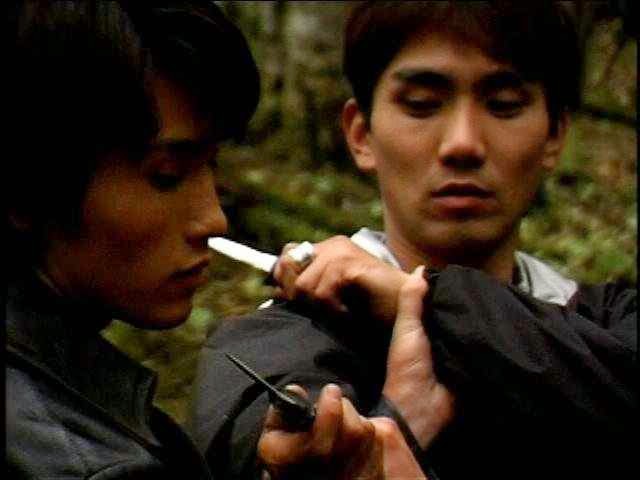
The film doesn't bear any names to reference its characters, including Sakaguchi whose role goes by none other than Prisoner KSC2-303. A sequel to late 90's zombie slasher, Down To Hell, Versus takes off with our prisoner and his inmate buddy escaping through the woods while still in shackles as they set off to a rendezvous point where they meet up with a ragtag squad of Yakuza led by an eccentric knife wielding lieutenant, and it isn't long before tensions increase and no one likes each other. Things eventually get worse when a mysterious young woman (Misaka Chieko) being held captive is pulled from the backseat, and our hero is instantly displeased with the situation. Soon enough, someone gets a bullet to the head resulting in a Mexican standoff with all guns drawn, and it is only seconds later that the same dead body suddenly awakens.

The Yakuza focus their fire on the undead body at hand while our hero and the girl escape back into the woods, ensuing a manhunt for both which takes the fight into the haunted forest where our characters are confronted by an army of undead rising from the dirt below. Of course, at the center of it all is our hero prisoner whose chemistry with the girl is nothing short of stiff while she continues to care for him, knowing almost full well what lies ahead in a story that jumps back and forth between two different periods, setting up an explosive finale of big guns, bigger bullets, and an epic sword duel between two warriors where only one can emerge as the victor.

While Sakaguchi wasn't a very good actor at this time despite having done a few stints in film, his performance served its purpose, lending an aire of unwritten charm and humor to his leather-jacketed tough guy exterior, and Misaka's role certainly helps. The overall theme we get from his character is, to simply put, a tough guy with a really vague past and a potential darkside. He doesn't believe in hitting women, but will knock a chick unconcious for her safety before he fights anyone, and he's the last person you would expect to be sentimental which brings just a little more humor to his character development. With this in mind, it's not until much later in the second act before going into the third that we begin to care about him more, fully engaged in hero mode with a missing eye, locked and loaded as he confronts actor Sakaki Hideo who plays "The Man".

Sakaguchi carries himself quite well through all of the action in most of the shots he is seen, with choreography by longtime collaborator and friend Shimomura Yuji, taking on numerous elements that comprise a lot of what we have come to know in action stardom. Even Kitamura himself has often lended the design of Sakaguchi's to the credit of a few known Hollywood movie characters, namely the Terminator and Kurt Russell's memorable role as renegade savior Snake Plissken in the Escape movies; Point in fact, if you own a double-disc set of this film containing some behind-the-scenes featurettes, you will see segment on set where Sakaguchi demonstrates several gun poses modeled off of classic action movie actors and director like Mel Gibson and Chow Yun-Fat. It's a pretty funny moment and very indicative of just how much fun this cast and crew had on the set of this film.

Versus is a definitive look into the mind of a director who once was told that there was no money for the kind of movie he wanted to make. It was also the start of an exciting an new era of Japanese action going into the new millenium, and Kitamura's career has grown ever since, with productions having gotten bigger and bigger with a roster of actors between Japan, the U.S., and several parts of Asia. That said, Sakaguchi shares quite a chunk of this legacy, having acquainted himself so well with the film festival scene in a role that has since spawned a cameo appearance in a shortfilm Kitamura directed a few years thereafter, and the hopes of bringing the character back for a Versus sequel. Unfortunately though, with all the talk of Sakaguchi's retirement after he finishes with Shimomura's latest directorial gig, Re:Born, any chance of a Versus 2 doesn't seem likely to happen, which is depressing.

Versus may not be an action packed blockbuster that takes itself seriously, but it offers plenty of reasons to care about the characters, to laugh often and be entertained. And with this, Kitamura and Sakaguchi have made a great pairing in bringing us a classic, with a slate of colorful and unique characters and a brilliantly vague approach that never really makes it clear just which side it is you should root for until the very end.

I sincerly hope that Kitamura follows this up somehow, even if it means recasting the role or introducing new ones to this universe. Versus is a true benchmark of cult fandom for Japan and fans all around, with a lead actor whose signature performance leaves a huge mark in history that further validates what makes Japanese action cinema so awesome.

Thứ Tư, 11 tháng 2, 2015

A CASE FOR BETTER ACTION MOVIES - Character Study: Toby Wong From DRIVE

The following is a version of a segment to a compilation article to which I contributed with other writers over at The Action Elite prior to its publication on February 10, 2015. CLICK HERE to read the article in its entirety.
While we await the verdict on the releases of several upcoming films featuring action star Mark Dacascos, perhaps one performance will continue to live-on in action movie history with a formula that undeniably serves fans of martial arts action cinema something worthy to hold onto. For this, we look to his memorable role in the 1995 action classic, Drive.

From a revised script by Scott Phillips, the film takes off in San Francisco with our lead, Dacascos starring as Toby Wong, riding as a stowaway on a cargoship that arrives on the West Coast as per his escape from the Red Chinese and the notorious Leung Corporation who have sent assassins to immobilize him and retrive their property. The catch? Well, that property just so happens to be a prototypical biotechnological enhancer surgically installed around his heart, pumping enough consistent adrenaline to essentially turn him into a one-man army, and Wong is in town to get it removed as soon as possible. With two bounty hunters hot on his tail, Wong coerces down-on-his-luck musician, Malik Brody (Kadeem Hardison) to drive him to Los Angeles in exchange for half of Wong's $5 million dollar payment for the device. Soon enough, their newly-formed uneasy alliance unites them on a mission that becomes much more about money, and with the help of a motel manager's colorful and quirky daughter, the two finally arrange a rendezvous with an ally that can help transport Wong safely to remove the device from chest. However, the relentless Leung Corporation has unleashed a final assault, in an epic finale that will ultimately determine whose heart is the strongest.

Directed by Guyver: Dark Hero helmer Steve Wang, the film came just a few years after Dacascos hit it big in Hollywood with the 1993 Capoeira-enfused American martial arts thriller, Only The Strong. Drive became a major film festival hit in Montreal and in Japan in the late 90's, hitting high notes among audiences with offers from two studios to release the film theatrically before being undercut by studio interference and politics that ultimately killed the film's potential before Wang knew it. The aftermath, resulting in a disproving alternative version, has since kept Wang from directing much of anything in the years since, even though it was once rumored back in 2010 that he and Dacascos would reunite for a 3D-caliber marital arts actioner that never saw the light of day. Be that as it may, Drive is still a classic that remains popular to this very day, staging high-impact fight choreography by action auteur Sakamoto Koichi with sequences attributed to some of the biggest gags ever applied in Jackie Chan movie history.

More to the point, you can't have a successful action movie without a lead character to care about, so while the butchered home release of the film stays linear with a straightforward story that keeps the pacing of the film's action short enough for the dialogue to exist throughout, the Hong Kong Legends/Medusa release on DVD in the UK not only revives the film's original score and a few deleted scenes, but also restores key aspects of the character development between Wong and Brody, sustaining much of the film's overall substance from start to finish. Dacascos turns in an electrifying screen fighting performance as Wong, serving him well as one of the best leading action stars Hong Kong never had in addition to his chemistry and comedic timing with Hardison, actor J.P. Ferguson and late actress Brittany Murphy.

The script never gets boring, suited with perfectly-timed gags and performances by Hardison and Murphy that will have you smiling from ear to ear, with Dacascos, in the role of Wong, exhibiting his own charm as well; The script provides a lot for Dacascos to work with, revealing him as more than a killer soldier and instead showing us a man with a personality relatable in almost everyway, cultivated in a love for American cars, music, beer and even movies. It's a layer of Wong's character that certainly called for an extended stay via what should have been a sequel and I absolutely loved the prospects of seeing Dacascos, Hardison and Murphy possibly working together again soon afterward. And it's sad that this never happened.

Drive was one of those films I ended up finding out about through word of mouth, and it took long enough for my local video store to gain copies of it on VHS before I would ever finally see it for myself in 2001. By far, despite studio malfeasance and poorly misguided distribution, Drive is one of the best martial arts action movies ever put on film. Hell, I loved it so much that I bought every single VHS copy my local video store had for ten bucks a pop (giving two away) before becoming a DVD junkie and buying a copy of the studio-cut DVD from my local Suncoast outlet in Manhattan before finding out there was an extended director's cut on bootleg which I mistook for a proper print - something I later rectified by becoming a customer at the now defunct website, HKFlix.com, where I bought not one, but two PAL coded discs from HKL/Medusa (the first one got scratched and became unrepairable despite my best efforts).

So...yeah, that's how much I loved Wang's movie and vision, and want so much for him and Dacascos, and Hardison if possible, to get as much of the band back together for one last hoorah in a film that could top the cult greatness achieved Drive: The Director's Cut. It may be difficult in our current film climate, but there's no question about it. The genre is still here and there is an audience that may lay dormant and waiting for these people to come back to the fray once more, provided the right producers and investors come along to make it happen in a way that doesn't echo past grievances.

P.S. - If you can still find a copy of the UK version on PAL with the commentary by Wang, Dacascos, Hardison and Sakamoto, I highly advise you go purchase it. The commentary alone is chock-filled with hair jokes, food jokes, fart jokes, ad-lib humor and wonderful factoids about the film that you would be delighted to hear. It's pure gold!

Thứ Ba, 10 tháng 2, 2015

A CASE FOR BETTER ACTION MOVIES - Character Study: Liu Jian From KISS OF THE DRAGON

The following is a version of a segment to a compilation article to which I contributed with other writers over at The Action Elite prior to its publication on February 9, 2015. CLICK HERE to read the article in its entirety.


For a lot of American moviegoers like myself, the 1998 blockbuster, Lethal Weapon 4 was our introduction to martial arts action superstar, Jet Li. His career would ultimately become a highlight for many a fan with DVD distributors releasing his films internationally online with HD renditions of classics from distributors like Dimension, Dragon Dynasty and Hong Kong Legends as Li's crossover would soon catapult him in stardom through some of his most memorable performances, including none other than the 2001 Chris Nahon-directed action classic, Kiss Of The Dragon.

The film sees Li in the role Liu, a Chinese intelligence agent assigned to France to assist Inspector Richard (Tcheky Karyo) and his unit of police stationed at a hotel awaiting to apprehend a crimeboss named Mr. Big ahead of a drug deal set to take place. However, the second Liu walks in, the red flags are already setting off and before he knows it, Richard reveals himself as Big's contact, killing him in cold blood whilst failing to take out Liu before he escapes with his life. Liu is now on the run with a courrupt high-ranking French cop and his men on his tail and almost no one to turn to for help until he meets Jessica, a prostitute with whom Liu eventually finds much more in common than he initially thought. The two make a reluctant deal for her help in clearing his name in exchange for getting her daughter back from under his far-reaching grip. The clock is ticking though, and with three lives now at stake, the ball is in Liu's court to use his deadly skillset to set the wrong things right.

Li wrote the story for this movie and as it turns out, he was also perfect for the lead role, presenting just the kind of leading man starpower required for a film of this caliber on top his action star credentials. Kiss Of The Dragon became more of a character thriller than anything else, revealing layers to Liu's personality that we could relate to, especially in his scenes with Bridget Fonda who plays Jessica, who is essestially the heart and soul of this film. The two have an awkward chemistry when they first meet, but the bond grows only closer as the film moves forward and it all pays off, right down to the climatic fight finale in Richard's police station. Of course, we could also ramble to no end about just how amazing the action is, with Corey Yuen at the helm. Having worked with each other before, it's pleasing to see these two collaborate so well in designing the fights, and its not just all about our protagonist doing contemporary kung fu superheroics and punching and kicking. Sure, we see some spectacle, but its not ham-fisted and cheaply written in. There's a method to Liu's masterful style of combat rooted in Chinese medicine and human physiology that makes him a certified killing machine, which makes it all the more delightful to watch Liu do what he does considering the odds, in addition to Richard's cruelty, cowering and hubris.

Kiss Of The Dragon a truly, artfully delivered and thrilling story of good and evil, centered on one man's stoic journey of love, honor, redemption and self-discovery through sacrifice. Liu's is a story of a man with a good heart, imperfect in every way with a life that has hardened him and conditioned him to be a self-sufficient survivalist when called for. As a result of the film's progression, the level of danger exhibted here almost perfectly sculpts the nature of Liu's character and humanity, giving us a reason to care about our his mission and why he fights in the first place, and exemplifies just why it is folks like screenwriters Luc Besson and Robert Mark Kamen are good at what they do on paper.

Come to think of it (though I'd be lying if I said I didn't feel this way before) I would go so far as to suggest that Kiss Of The Dragon is my absolute favorite Jet Li film of all time next to Unleashed. Everything from the story and character development, to the poetic fight finale between Li and fight duo Cyril Raffaelli and Dider Azoulay, the music and performances from Fonda and Karyo and the recapitulating track by Massive Attack toward the end credits, are all qualifiers on this behalf. Point in fact, it's films like Kiss Of The Dragon that make me want to go to the movies and enjoy some of the most pleasing moments on the big screen - moments that makes you cheer and cry with tears of joy, moments that can either anger you or make you laugh, essentially bringing you along for the journey, which seldom happens at the movies.

This is what good writing and directing does, as well as good acting, and in that respect, Jet Li completely owned this character. Suffice it to say, I would have loved a sequel to this film just to see where a character like Liu Jian could go from there. Even at the end, we still don't know everything there could be about his background as much as it is all a mystery while the film focuses on where it needs to be from A to Z, and I wasn't bothered at all with this after enjoying such a fantastic film. Granted however, and if Li's current health weren't an issue, if Besson and Kamen or another screenwriter were to revisit this character for a continuation of Liu Jian's story in some capacity, I would not argue.